Tuesday, 14 December 2010

The Boat That Rocked - Marketing (Viral and Trailer)


One poster for TBTR

The Boat that Rocked – Lack of Viral campaign.

There was no such viral marketing campaign for the boat that rocked, however there was still a strong marketing campaign following key conventions of many British films. One reason for this lack of Viral marketing is that unlike American movie companies British ones just want to get the film made and do no worry about marketing until post production. However in America throughout the production of the film they are always thinking about how to market the end product.


Trailer

The 39 seconds teaser trailer was released before the full one minute 30 second trailer in cinemas, this got people talking about the upcoming film. It gave little away which captivated the audience. Further more it made people aware that:
  • The film was opening
  • Who’s in it
  • Genre
  • Idea of story

Both the teaser and the full length trailer require requires synergy, the teaser haven given the audience an idea about the film, the film trailer should take the idea further and develop it. TBTR trailer did that, it revealed more about the main characters as well as giving away some of the plot.

Why no Viral?

Social networking sites are very influential in successful viral campaigns
It was a traditional British film that stuck to posters and trailers, despite these drumming up initial interest in failed to live up to its budget retaking only a quarter of their production budget. Another reason for the lack of viral campaign may have been because of the adult target audience. The primary target audience was 35-60 year olds who grew up around pirate radio, this is an age group that are not known to be big users of digital technology and the internet such as YouTube, Facebook and smart phone apps.

It is through these platforms that viral campaigns are most successful; one flaw of the campaign is the Facebook page for the film targets younger audience who the film did not appeal to as it was a period film. 

Reviews state that ‘If you liked ‘Four Weddings and a Funeral’ and ‘Love Actually’, you’ll love ‘The Boat That Rocked’.’ All free films are related as they are great representations of British society.

Sunday, 12 December 2010

How Avatar was made: new technologies

James Cameron makes film to push the boundaries and develop technology. Each of his films get bigger and bigger, more money is spent on them and incredible new technology found to enable the film and editing of them. Cameron introduced the first “motion capture” characters and included the first human movements in CGI in Terminator 2.
It took 4 years to make Avatar, about two thirds of it being computer generated. However, live action filming was also used. Footage was filmed on sets, against green-screen backgrounds. Computers (called Simulcams) transformed the actors into their Avatar characters in real time, so that director James Cameron could see exactly what the final shot would look like. He was able to change the computer generated image immediately, while still on set, such as moving scenery or even location in the virtual world. Essentially, it is a similar technology to what computer games use. Cameron said “it is the most difficult thing I have ever done”.
The production team spent the first year and a half perfecting the translation of facial expression from the actors to their CGI Avatars. They had to develop a whole new technology, as previous methods produced unconvincing results. In the end, the actors wore special head rings, which consisted of thousand of camera only an inch from their faces in order to capture every slight movement.
Avatar was also filmed in 2D and 3D. For this, James Cameron and Vince Page, camera expert, developed a new, lightweight 3D camera called Fusion.
The technology used to make Avatar is extremely convincing: cinema-goers are truly immersed in the world of Pandora, the 3D effects are far from gimmicky. The fact that the technology is unique to Avatar means that it attracted a massive audience.

Do you have comparative material like this on TBTR?

Thursday, 9 December 2010

Marketing- Avatar (Global and Online)


Avatar's marketing budget was speculated to be in excess of $200 million although the exact figure has never been released. Aswell as the fairly unsucessful viral campaign on AVTR.com, 20th Century Fox also had a more traditional campaign which proved INCREDIBLY sucessful, utilising other giant media/ business conglomorates and social media to great effect.


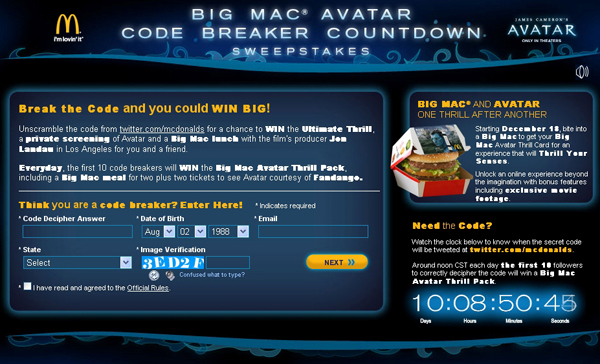
McDonalds and Avatar

McDonalds and 20th Century Fox (two of the most POWERFUL GLOBAL businesses) partnered together to create a symbiotic marketing campaign which was mutually advantages to both sides.  


PANDORAQUEST

"The fast food chain has developed an interactive game that explores Pandora, the world where Avatar takes place, via high-resolution, 360-degree views - among other sci-fi marketing touches."


The game called PandoraQuest was accessible on McDonald’s local Web sites around the world from December 18 2009. The games goals included finding hidden objects within three different Pandora landscapes. Retrieving all objects enables the player to advance deeper into Pandora and reach their goal of becoming a member of the “RDA Research Team” as seen in the movie.

A key component to the game was McD VISION, an augmented reality experience that immerses players in Pandora. In addition to this was PandoraROVR a vehicle which can transport the player all around the web version of Pandora.

From the Press Release:
“McD VISION: An augmented reality (AR) experience that uncovers characters and scenes from the film, and immerses players in the world of Pandora. Players use their "McDonald's Thrill Cards" available in participating U.S. restaurants (through Jan. 7, 2010, while supplies last) to interact within AVATAR's fantastic world."

“PandoraROVR: An online discovery experience where players can take their first steps on Pandora, putting them in the driver's seat for interactive explorations of Pandora's terrain. The players' mission is to roam freely, capture and share images of their exotic discoveries.”


This marketing campaign crucially helped to connect online advertising with in-store purchases. For example, interactive toys in Happy Meals and AR ‘Thrill Cards’ with Big Macs, targeting the gaming demographic, that become part of the experience in the online Pandora when held up to a webcam.


A 3-D film, Avatar 'sets the bar high for customer engagement tie-ins,' McDonald's U.S. chief marketing officer Neal Golden said. But according to Cameron, the restaurant chain has delivered with its tech-heavy, futuristic look. "When I set out to write this movie, I knew that the [computer generated imagery] was about to create a situation where we could do anything that we could imagine," he said.
"McDonald's has stepped up and met that same level. I don't think anyone has seen anything like what they're doing with these tie-ins, the McD vision augmented reality in particular."

SOCIAL MEDIA
McDonald's also ran a Twitter campaign, asking followers to be the first 10 to decode daily word scrambles. The grand prize was a private screening of Avatar over a Big Mac lunch with producer Jon Landau (Source: Promo Magazine.)


Stats released the week beginning Monday 25th January 2010 showed that:
  • Total global receipts of the film had reached $1.858 Billion
  • This is $16 million ahead of the $1.842 Billion earned by Titanic, but Avatar hasn’t even finished yet.
  • Avatar has a shot at topping $750 million at the US box office and $2.5 billion worldwide. 
Many people believe that the films huge earning were due to the global marketing campaign and social media proliferation.


To further exacerbate this point:

Avatar on Facebook had
  • 1,149,471 fans as of 28th January,2010
  • 1,518 fan photos
  • 3,235 links


Avatar on MySpace had 796,182 friends


Avatar on Twitter had 24,800 Followers


In addition to this the 'Blogosphere' was inundated with posts about the film, trying to post spoilers, images, any and every tiny detail of information on the film shrouded in secrecy and enigma to the extent that many knew of the film the previous autumn! (That is one hell of a buzz!)


If that wasn't enough the Avatar YouTube page drew in millions of fans in their drones, loaded with behind the scenes information and fake videos by the character Dr Augustine.


This is all excellent but you need the same for TBTR for comparison. You also need to relate back to the key concepts more explicitly - drawing conclusions is essential.

DVD Information

Released on: 7th September 2009

Online, it was initially sold on Amazon and Play.com
you could pre-order the UK DVD on Amazon

A bluray review:

"The Boat that Rocked’ is set adrift on Blu-ray with a very good Region Free 1080p VC-1 encoded transfer of this recent movie, framed in its theatrical widescreen aspect ratio of 2.35:1.The pale British skin tones are faithfully reproduced and the image is sharp with healthy levels of contrast throughout.
The DTS-HD MA 5.1 soundtrack really does rock like the boat with period music from a wide range of artists. The DJ dialogue is crisp and intelligible while the waves buffet the walls of your lounge courtesy of the surrounds and subwoofer.Among the extras we have an interesting comm. track, a shovel load of deleted scenes as well as a raft of mini featurettes.
As a movie it’s a humorous tale of pirate radio, filled with on board antics as our heroes battle with a spoilsport British Government of the day to broadcast their own kind of music. Worth a spin."

Its RRP was £24.99 on bluray, £19.99 on DVD

DVD sales within the first week: 53648 copies earning £659,502

Purely descriptive content - where is the theory and analysis?

Film Reviews

Different film reviews:

Online reviews of film:

"Poor storyline
Poor execution
Way too long
Incredibly disappointing film!!"
http://www.odeon.co.uk/fanatic/film_info/m11601/The_Boat_That_Rocked/

"Having been there ( secretly listening to radio Caroline under the pillow as a youngster) and growing up to the music of the sixties, it was both nostalgic and funny." http://www.odeon.co.uk/fanatic/film_info/m11601/The_Boat_That_Rocked/

"In Whitehall, thin-lipped minister Kenneth Branagh – wearing specs like Burt Lancaster's in Sweet Smell of Success – has decreed that pirate radio must be routed. To this end he hires a mandarin to nobble the Radio Rock crew. The name of this mandarin? Twatt. And the name of his assistant? Miss Clitt. It makes the later Carry On films look like Sheridan. Truly, it's a chilling moment when you realise that this whole film is in the hands of a man who thinks "Twatt" is a hilarious name for a character." The Independent


The reviews will have influenced people on whether or not they went to see the film, or bought the bluray DVD etc. The mixed review response will have meant that many people that read the reviews would have been doubtful about the quality of the film, lessening the sales figures.

The Boat That Rocked Core Questions

Sorry it took so long guys- here are the answers to those pesky a-e questions on TBTR.

a) What genre of film is it?

(British) Comedy film.

b) When was it made/ released?

The film was released on 1st April 2009 for the UK, and was re-released in the US, under a new title 'Pirate Radio' on the 13th November 2009.

Principle photography for the film began on 3rd March 2008 and continued through to June 2008. The movie was filmed in the second half of 2008, in time for it's April 09 release.

c) Where was it made/ released?

Filming took place on the former Dutch hospital ship Timor Challenger, moored in Portland Harbour, Dorset; the North Sea scenes were shot off Portland Bill, while boat interior shots were filmed inside a warehouse in Osprey Quay on the Isle of Portland and at Shepperton Studios. ( << definitely not nicked from wikipedia)

Other locations included various streets in London, the seafront at Brighton, the national gallery in central london, and at some geezers house in Kent.

d) Who made it/ distributed it?

TBTR was directed by Richard Curtis, and was produced by Tim Bevan, Eric Fellner and Hilary Bevan Jones.

The film was partially funded by StudioCanal, a french distribution company, and was made Working Title Films - a successful British production company.

The film was then distributed by Focus Features and Universal Pictures.

e) How was it made and released?

The film had an estimated budget of £30 million.

They released the film first in Britain (see above), as the movie is very British. It was met with mixed reviews and did poorly at the box office, only grossing £6.1 million in it's 12 week run at the British box office, less than a quarter of it's total production costs.

They hoped to make some more dough by re-releasing the film in the states (see above) under a new name 'Pirate Radio'. Also, responding to heavy critisicm that the film was far too long, Richard Curtis trimmed twenty minutes from the run time to meet the US release. They also released the film with a 'radically different marketing angle'. However, the film massively bombed in the US aswell, earning just under £5 million across it's entire theatrical run.

The marketing campaign for TBTR was fairly standard, they utilized many teaser and theatrical trailers, tv spots, and colourful, eye catching posters. The film relied heavily on it's musical influence and strong soundtrack for marketing, their soundtrack including hits from The Rolling Stones, The Beach Boys, Jimi Hendrix and The Who. Some of these tracks were used in trailers to help convey the musical nature of the film to audiences.

The film also relied on it's strong British cast. Big names included Bill Nighy, Nick Frost, Rhys Ifans, Jack Davenport, Emma Thompson and Philip Seymour Hoffman. The teaser posters released for the film focused on the strong cast, the fact that they are known well in Britain adding to the British appeal the film holds.

Wednesday, 8 December 2010

The Boat that Rocked - Production Notes from Program

 
CONCEPT

Richard Curtis
The idea for ‘The Boat that Rocked’ was an original one, written by director Richard Curtis.

Producer Eric Fellner then approached his company, Working Title, and persuaded them to produce the film.

Working Title is allied with Hollywood studio Universal Pictures, meaning they had plenty of financial backing. The link between the companies also provided a guaranteed means of distribution.

Eric Fellner, one of the producers of The Boat that Rocked is also a chief executive of Working Title. He ensured that there were minimum problems when making The Boat that Rocked, from beginning to end.

The director then begins to plan the filming, by creating a script.
The creative team is set up, and casting begins.

PLANNING

The script provides a blueprint
During the planning, the budget must be set.
A major part of the discussions is deciding on “what the audience will find believable”.
TBTR is set in the 1966 – 60s feel
-          People from this era are still alive, so the ‘look’ of the film must be accurate
-          Designers use archives to research
During planning, locations are found, most being 60s relevant in this case, for example government buildings, London streets, listeners’ rooms.
The production designer oversees this; while liaising with the costume department and director.
Sets are carefully planned, then built or altered accordingly. The crew spent 4 weeks filming on a boat in Portland for TBTR, so they had no factor in weather and tide.
Costumes were based on 60s fashion, and its rebellious nature, while taking into account the actor/character style.
FILMING

First, the director looks at the script and breaks it down, while liaising with the producer and cinematographer. Each scene is carefully planned.

A lot of things need to be taken into account – most of the footage is filmed on a boat, so the set size was an issue. Weather also had to be taken into account.

The director uses a CALL SHEET to make sure that the right people were on set at the right time. The call sheet also outlines what equipment is needed as well as what needs to be shot.

In TBTR, some scenes had to be cut as it was impossible to film them on the boat – not everyone could get aboard.

1st unit and 2nd unit filmed simultaneously.

EDITING
Putting the scenes together from the day filming begins, so that the director can see immediately what his movie is beginning to look like.
The editor works closely with the cinematographer and director.
Music is added, from the 60s
First cut of the movie is made, which was about 5 hours long. Scenes are cut and trimmed to finally achieve a movie 2 hours and 6 mins in length.